Most questions about writing are loaded, and they require reading between very many lines. They usually are versions of these two questions:
1.) Will such and such make me a better writer?
2.) Will such and such help me get published?
We should note that those questions are not about the same thing. If getting published required someone to improve their writing, a lot of currently published bestsellers would have never made it past the acquisition editor’s desk.
The only thing a writer should do is read and write. You really can’t do one without the other, not if you want to compose engaging texts. That’s the short answer.
The long answer is more interesting. Will travel make someone a better writer? Travel, when done outside all-inclusive resorts, builds empathy. It offers alternative points of view. Travel enough and you’ll learn that everybody considers themselves the center point. I’ve heard people from at least six other countries tell me they come from the greatest country in the world. (Russia, Canada, Australia, Germany, The UK, New Zealand)
Travel also disarms the traveler. It can, when done with the right purpose, displace mythologies. Travel raises questions that have no answers. It also displaces common explanations. Why was Rome built where it stands? Well…there’s the Tiber. Yes, but Rome stands elsewhere, not just on the banks of the Tiber. Fifth grade geography class has its limitations.
All of those things make someone a better thinker and citizen but not necessarily a better writer. We can work on our observations skills in our bedrooms. Their application on trips really does reveal things that are otherwise invisible.
Of course, some of the best writers never really went anywhere. One thing they all did, however, was read, and they read whatever they could get their hands on. Travel is fun and engaging, a much more rewarding way to pass the time than, say, watching NFL games. It’s not as expensive as people think, certainly not when compared to its benefits. One thing I always have in my bag when I’m traveling is a book. It’s usually written by someone very different from me.
Well, someone finally noticed this, so I feel I should respond. “Hey, Gint,” a reader asks, “What’s with the age gaps between the lovers in your books? Is Lita Avila an allusion to Dolores Haze?”
The reader has noticed that both Finding the Moon in Sugarand The Fuguedepict lovers with a notable age difference. Perhaps naturally, they’re wondering if I have some kind of fetish.
Audra and Andy from Finding the Moon are probably more than a decade apart. Andy, born in 1986, claims he was never able to figure out Audra’s true age and puts her birth date somewhere between 1977 and 1972. Of course, Audra’s vain and a liar, so her email address, audra1974@zuikis.lt might be set up to make her seem younger than she truly is. Dazed and confused, the stoner boy Andy never notes the year in her address as evidence for anything. If Audra is truly born in 1974, it means she and Andy are twelve years apart.
Yuri and Lita of The Fugue have a wider gap. Lita’s just a teen when they meet, and they are almost two decades apart. Neither character seems to think much of this, and (minor spoiler) Lita’s family are all either dead or gone by the time her initial crush on him evolves to something more mature.
When I wrote and self-published Finding the Moon in Sugar, I thought The Fugue was a dead project that no one would ever read. I was definitely conscious of the repeated age gap—that makes it a motif, right?—but didn’t worry too much about it. Once I knew The Fugue would be published, I figured the only way someone would catch it would be by reading both books, which would be wonderful if they did. To me, Lita and Yuri’s relationship is a rich construction that reveals so much about both characters and also the nature of trauma. I had no intension of tampering.
Now…did I have Nabokov in mind when I chose the name Lita (the character’s full name is Angelita Avila)?
Nabokov’s Dolores (Lolita) Haze is Humbert Humbert’s victim. Humbert is not merely her abuser and rapist but also her legal guardian. And while Hum suffered the tragic loss of a child-lover while a kid himself—an experience that leaves him searching for a surrogate or an incarnate…an avatar, if we will—he admits that he deserves to be tried and sentenced, even if he does beg readers for leniency and forgiveness.
Yuri is not victimizing Lita. For much of the time after first leaving prison and returning to Cicero, he is hardly able to interact with anyone, so shell-shocked that he imagines buildings that aren’t there, and he can’t know how to thank Lita for her gift of a broken bicycle. He later sculpts her portrait not out of a desire to possess or control her but as a way to release his affection, which is probably discomforting, though not necessarily because of Lita’s age: Yuri has lost almost everyone he has ever loved, and now a stranger has given him a gift.
It’s true that Lita’s portrait is crossed with his memories of other women—Lita’s is not the only portrait he has sculpted. And Lita, young and self-conscious, never imagines he has sculpted her portrait. When she guesses it represents some other woman, she’s partially right.
Honestly, when I thought of the name Lita, I was also thinking of names for other characters. So my concern with the name Lita had less to do with Nabokov and more to do with its similarity to Alina, Yuri’s interest from his teen years. I wanted names that seemed shades of one another…variations, if you will. (In an early draft, Alina’s name was Lina.)
I was reading a lot of Nabokov at the time, so it probably did things to my mind. But I didn’t see Yuri and Lita’s relationship as taboo or profane, and I didn’t think of Lita as Lolita’s literary variation, at least not consciously.
I should probably say that I had several crushes on older girls while still a 13 and 14 year old at summer camp. One of those girls turned out to be a lifelong friend. I’m sure the intensity of such feelings and experiences evokes itself in my writing all on its own, without me needing to do very much.
Still, in future novels, what lovers I surmise will all be around the same age. I feel like I’m done exploring these age gaps and that my fiction has expressed what I wanted, even if I can’t say what that is.
This question came a while ago from someone who has read almost every available work of fiction I’ve ever written. While my novel, Finding the Moon in Sugar, saw very few reviews, several reviewers commented that the book had no ending. Reviewers of The Fugue have not made similar comments…not that I remember. But the reader asking the question felt the final paragraph of The Fugue is even less an ending than the final bit in Finding the Moon.
I find this really fascinating. It goes completely contrary to my process and point of view. I don’t feel I can really start writing something until I see how it ends. I’ve said in many interviews that The Fugue started out as a vignette of a man repairing a window. I didn’t know I had a novel until I imagined the very final scene. The horror and displacement convinced me I had a novel.
All this aside, my endings don’t offer resolution. I find resolution to be among the greatest contrivances in literature. I don’t think of narratives or time in linear terms, but if we do think this way, a cliché applies: all roads lead to the same destination, and that destination is a mystery. There’s a difference between writing the last word of a text—always an energizing moment—and resolving the narrative’s problem. A good ending is one that leaves the reader feeling obliterated or provoked. It is not one that leaves the reader with the delusion that now s/he “understands something” or, worse, “understands everything.”
There’s no way to answer this question in detail without discussing the actual endings. As a person fascinated with love and death, I write about not knowing. One of my most important themes, I think, is ignorance, especially the kind of ignorance we can’t perceive. So I don’t try to answer any questions in my fiction. My fiction is a way for me to express my ignorance, and my endings work to that end.
At this point, I’ve gathered enough questions that I can start blogging on a more regular basis. I’ve found some to be really the provocative.
So, here’s the first:
How’s it feel to kill a character?
I’d be lying if I said it wasn’t fun sometimes. To blow off steam, sometimes I’ll just write torture scenes in my notebook, most so over-the-top that they become nonsense. “Blood and brains were everywhere. Everywhere. She’d find bits of spongy brain in her pencil case months later.”
Of course, sometimes the death of a character is a really intense moment. Death is a central theme in my books, especially in connection to religion and love. I’ve written death scenes that have left me crying afterwards. There’s one particular bit in The Fugue that I feared writing. It has to do with a hanging. When I did finally complete it, I went for a long walk through Morningside Heights Park at around 2:00 AM.
I think it’s important to explain what assumptions I bring to my writing. I don’t feel very strongly influenced by the Hollywood narrative in which the good guy survives. I assume I’m treating representations of real people, and so death is a certainty for every character I’ve ever written. Sometimes that death happens within the plot, and some deaths are more gruesome than others. In The Fugue, some people burn alive; another one goes to sleep and never wakes up; a third is killed in a bus shelter; one guy gets kicked in the head by a horse.
I’ve never written a character just to kill them off. Unlike a writer like Flannery O’Connor, I don’t feel that death is a punishment or an instrument of God. To me, it’s part of life, like the rain or the sunset. Readers should notice, however, that unlike Tolstoy in Master and Man, I’ve written very few in-the-moment death scenes. There are two important ones in Finding the Moon in Sugar. In The Fugue, a character named Lars is near death, feverish and delusional in one scene, but he comes out of it. A lot of the deaths happen “behind the scenes” and are either discovered or noted by other characters.
Of all the scenes I’ve ever read, I feel that Nabokov must have had more fun than anyone else writing Humbert Humbert’s murder of Clare Quilty. It’s a romp, at once sublime and profane, and even includes a poetry reading. I think the reader enjoys, at least partially, watching Quilty go. I’d be shocked if readers found characters in my books they wanted to see destroyed.
However, I’m working on one now that people will probably want to see tortured. I haven’t decided what I’m going to do with him yet. But his fate won’t be easy.
This past week, the Chicago Tribune ran this review of my novel, The Fugue. The reviewer, fellow Chicagoan Dmitry Samarov, called the book “magisterial,” said it goes for all the marbles and compared it to Dostoevsky.
Other commentators have compared my writing to other writers that I love, including Nelson Algren.
All these conversations are insane. They don’t feel real. I’m certain a moment is arriving when a director or other puppet-master will say, “We’re finished, thank you,” then turn off all the lights, unplug the equipment and send all the players back to reality.
I have so many questions about how this all happens. How is it that you read the books of the writers you love, write your own book and then end up getting compared to them? The comparisons are obvious compliments. But what’s going on? Have I internalized these forms, or are they attractive to me because I found parts of myself swimming in them, parts placed in a text long before I was born?
My publisher, Jerry Brennan of Tortoise Books, recently wrote a blog post to share his thoughts about taking over publishing and production duties for The Fugue. Writers aspiring to publish novels should read it. Today I want to expand a bit on Jerry’s thoughts.
It turns out that, unbeknownst to either of us, Jerry and I were students at Columbia University at exactly the same time. He was at the J-school while I attended classes one building to the north at the School of the Arts.
I often used to peer at the J-school and feel pangs of jealousy. Journalism students, I was sure, didn’t struggle with feelings of illegitimacy the way I did as a mere writing student. They were all sure of themselves and would one day offer society valuable skill. How could I know one of them would be publishing my book?
It’s possible that Jerry and I ate in the cafeteria at the same time or stood queued up in the bookstore at the very same hour. I would pass the J-school every single day, no matter if I was going to class or to the library. Al Gore was teaching there, and I once tried to pry in to a lecture only to get paranoid at the last minute and hide away. Jerry attended those classes.
I’ve known Jerry on Facebook and Twitter ever since the publication of Finding the Moon in Sugarin 2009. He and I caught wind of one another through Chicago’s indie writing community. Of course, I had no idea we had been classmates, trading places in rather classic ships-in-the-night fashion. I was quite literally working on the earliest version of The Fugue while Jerry was studying under Al Gore.
I experienced a roller coaster of a day this past February when CCLaP and I parted ways. In less than twelve hours, I went from being suddenly unpublished to published again, with a new marketing plan and a ton of support.
As with virtually anything in life, luck and diligence conspired to see me find a second deal. And I see no small bit of weirdness in the story, that a book I had essentially put under my bed, hung up as a failure, ended up published not once but twice, and in the span of less than a day, the second time by a guy from essentially the same graduating class.
I got good advice from wise people when I published Finding the Moon in Sugar. Here it is: reach out to everyone you can and take an active interest in other people’s businesses and stories; look at others in the publishing world as collaborators, not competitors, and understand that a team effort is necessary for a book to do well. Of course, many things are just beyond your control. You go to graduate school, at least partially, to “develop a network”. How fitting that a guy in my network was someone who shared my college experience when neither of us had any idea until the ink had dried on the contract.
This is about a 24 minute video of me answering moderator Amy Danzer’s questions following my reading at The Looking Glass Bookstore in Oak Park, Illinois on February 18, 2016. Yes! That gorgeous bookstore in the background is right here where I live. It’s worth visiting just to see the decor (and to buy a bunch of books, obviously).
In this video, I answer questions about why I’d want to write a literary fugue, what place setting plays in my writing, how art helps with trauma, and what audience I had in mind while writing.
Enjoy, and do share.
Also, be sure to check out my fledgling YouTube channel. It’s sure to grow as I gather more videos.
The reason I’m asking this question is because The Next Best Book Blog has run an interview of me today (click here) . It’s a series called Would You Rather, and the header asks a rhetorical question: Bored with the same old-fashioned author interviews you see all around the blogosphere? I had a load of fun answering those questions and I hope you’ll check it out.
I got to thinking during the interview. I’m not like those authors who want to cut themselves when they hear “Where do your ideas come from?” or “What are your greatest influences?” As I blogged yesterday, I often forget my influences, but I also feel a bit ashamed about them; so many are the usual books writers are “supposed to know”. Still, if I had to pick from among cliches and sentiments, I’d rather answer questions like, “Does an artist have a responsibility to society?” or “Is there any way to bring back the noble hero?”
Asking a writer where ideas come from is obviously loaded, and to certain parties can be a put down. What do you mean where do my ideas come from? They come from me. I know a lot of people assume they “lack ideas” (they don’t, and more about that in a moment), and ideas must “exist somewhere”. But how would we feel if we asked a writer, “Hey, where do you get your ideas?” and s/he answered, “A vending machine outside Hammond, Indiana.” Would we seek out that machine? Would the art be interesting, then, if you could buy it for a quarter?
Any time I hear a piece of beautiful music or read an amazing book, I’m stunned by the artist’s creation. It’s shocking to think there existed nothing, but then an artist came around and released a symphony or an epic poem or a monumental sculpture straight out of empty space. It must have a source! Where? Tell us where!
That hope for a source is worth investigating.
I had a neighbor once tell me—most writers hear something like this—that, despite never having written a thing, she should write a book about her life. I asked why. Oh, she said, my ex-husband cheated on me, and I had a tough childhood, and my eldest daughter is in therapy over my ex-husband’s affairs, and I used to work in hospitality but I quit because I thought I’d raise a family.
She felt the weight of all this experience, all the sadness. I could sense it. But was it all that different from what anyone else has ever felt? Who knows. The book she imagined doesn’t exist. She never found (or carved out) time to sit and write.
Curious things happen when you force people to sit and write. I see it among my community college students. Most of them—perhaps 90% of them—believe they lack ideas. They’ll prove it to you: ask them to write a regular old college essay and it will drip with “say no to drugs” and “it’s unfair to be judged” cliches high schools dump into young brains. But when you make them freewrite—just keep pen to paper for ten minutes without pause and allow whatever comes to come—all kinds of intimate surprises appear.
If you want to know where writers’ ideas come from, try freewriting. When you see what’s there, what came from you, ask yourself which of those bits you’d be willing to develop and share with strangers. That’s what a writer is. We share the bits most people pack away while wondering where the good ideas are.
This is a blog version of the story I told on December 14th at Is It a Thing, a monthly spoken-word series here in Chicago. I’m dedicating it to my good friend Kerri Smith Majors, who asked me to write it. Note: the post contains excerpts from The Fugue.
Here’s the question posed in this entry: What did editing a manuscript I had not looked at for more than a half-decade reveal about my PTSD?
I’ve already blogged about the 15 year path that led to the publication of The Fugue. The first words came in 2000. Once finished, I failed to sell the manuscript and put it away in 2006, later beginning work on a new project, what eventually became Finding the Moon in Sugar. I considered The Fugue a failure and stopped trying to get anyone interested.
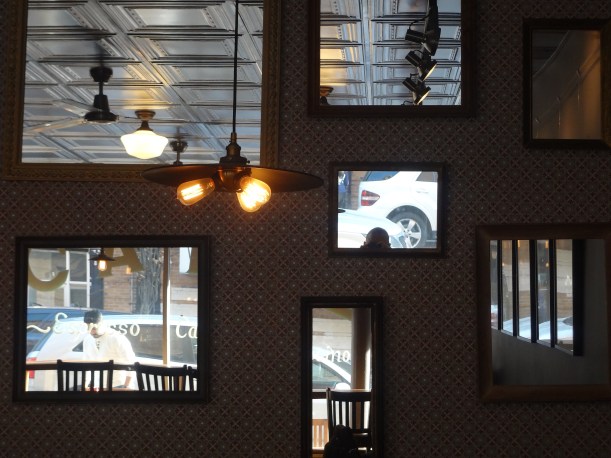
A short time after I self-published Finding the Moon in Sugar (2009), I ended up diagnosed with PTSD. Its onset came after* I got caught in a convenience store robbery, which I blogged about in this entry titled Gunpoint. To summarize: I was certain the robbers were going to kill me that night, and I accepted my death while watching the robbery unfold, reflected in store windows.
I obviously survived, but not unscathed. Within a few days, I started having PTSD symptoms. My PTSD was (and sometimes still is) like a bad and incessant acid trip, complete with phantom sensations, memories of voices, unusual sounds, smells, flavors and inexplicable visions. The visions can be hallucinogenic and dreamlike or frighteningly realistic. I’ll write about them some day.
Doing something as simple as brushing my teeth or making a cup of coffee often brought on confusing sensory overload. My body experienced “phantom pains”, especially in my face and ribs, and my throat would constrict. I’d want to run and hide but could only sit somewhere and trip balls. I’d get lost in neighborhoods I’d known all my life, the street signs resembling electronic tickers, letters of all languages flying in them at unreadable speeds.
In order to heal, I had to make dramatic changes to my lifestyle. With guidance, therapy, a commitment to health, mindfulness and Zen practice, and the help of many loved ones, I eventually learned to manage my symptoms, even to neutralize or eliminate some altogether. Writing helped. So did telling my story in public.
***
In 2014, I was reading from Finding the Moon in Sugar in a bar. During that reading, I met Jason Pettus, the owner of The Chicago Center for Literature and Photography. He asked if I could send him some material to review, and soon enough he offered to publish The Fugue.
I had last looked at the manuscript sometime around 2008. When Jason and I started editing, I was shocked by some of the things I found. The main character, Yuri Dilienko, grows up in a dysfunctional, abusive family, its members traumatized by war and other events. He also ends up in prison for over a decade, found guilty of arson and parricide.
Early in the narrative, a character suggests Yuri might have PTSD. Of course, I had completely forgotten this. Then my descriptions of PTSD “in the moment” left me thunderstruck.
In this excerpt, Yuri’s just been released from prison, has moved back to his hometown and is thinking of getting a job in a bar. The reason he hesitates showing his hands is because they’re dotted with scars suffered in childhood:
—
He noticed a “Help Wanted” sign hanging behind the bar, so low that only people at the bar could read it. Maybe this was some kind of subtle joke, because people who sat at bars usually needed help. Yuri imagined working there. Most of the men were only drinking beer, and if they ever wanted something different, scotch and soda, Yuri was sure he could mix it.
“I’m sorry.” Yuri spoke to a bearded man. “Excuse me. I’m sorry.”
The man perked up. “What for?” He lit a cigarette.
“That sign there. Below. The Help Wanted.”
“The sign? Oh, for the job?” He rattled and stuttered: “Yeah, that’s…that’s for the job.” The man coughed into a loose fist. “Hey, Sonia!” She stepped over from the bar’s other end. “If you want the job,” he told Yuri, “Sonia’s gotta read your palms.”
All the other men now seemed interested.
“You wanna job?” asked Sonia. “Is por bartender. We have the day position.”
Yuri shrugged. “Daytime? You mean what? Noon?”
Sonia smiled at him. “I see your hands. Both hands.”
Yuri hesitated. The whole bar was watching him, some of the men grinning. He wanted to take his cane and tell the people he was very sorry, it was a big misunderstanding, because he had to go. While looking at their intense faces, pockmarked skin, lopsided mustaches, Yuri felt surrounded by the most violent men—grotesque and incapable of compassion, their eyes the color of mortar. His mind began racing, as it did often when he found himself confused or surprised. Strong, hard hands grabbed at him from all around and a shiver buzzed over his entire body, electric over his chest. He was powerless and could only give in, curl up, let the blows come, let them pass, then bury rage and fear deep in his center, deep into his pelvic bones and base of his spine.
—
In this next scene (slightly edited), Yuri is working in a butcher’s shop. It’s only days before the house fire that will take his parents’ lives:
—
A powerful force in his center, like a glass sphere packed with the molten heat of a red sun, wanted to charge up his throat.
At the end of the workday, Reikel smiled to Yuri as he left, said, “See ya Monday.” On the way to the bus stop, Yuri threw up his lunch…popcorn, salami and apple juice. This was the third time he had thrown up, the onset of nausea unexpected, gone as soon as he had vomited, since he had shown Reikel his hands. Nobody ever saw Yuri vomit.
Cicero had become a ghost town surrounding him. Hundreds of sparrows were chattering in a small yellowing elm. Their bickering and chirping grew so loud and overwhelming that Yuri stood entranced until a woman exited a nearby car.
On 12th Street, he saw his bus lumber away without him, so he went to a diner to rinse his mouth in the bathroom and wipe his face and chin to be sure he was clean.
Once home, he couldn’t sculpt. Every idea and sketch seemed pointless and stupid. He was always hungry, although nothing tasted good and no drink quenched his thirst or whet his constantly dry mouth. The hardest place to be in all of Cicero was home. While he sat in his kitchen, it felt as though parts of him were gradually disappearing. Yuri felt extreme nervousness, a shifting fuzziness in his periphery, and that powerful glass sphere inside him.
Everything required hands. At Reikel’s, his hands seemed to do what he asked them, but at home they refused to obey. Everything required hands. Warming up a plate of leftover macaroni and cheese. Washing himself, his entire body…before he could wash his body he’d have to wash his hands. Flipping through the sketches on the table seemed such a chore. When Lars used his hands, music came so easily, like air through a wide open door. Yuri could tell that Lars never thought about borrowing hands or finding new ones, and he didn’t have nightmares that his hands were left wrapped up in aluminum foil at the bottom of a paper bag…
…Whenever he awoke, he had trouble knowing what day it was. He found busses running on the Saturday schedule. Weekends were the worst because he had so much time to sculpt but found plenty of excuses, shopping for things he didn’t need—paper clips and deodorant—always walking to the largest stores on 22nd with the biggest crowds. Among these people, nobody knew. Sometimes Yuri walked out on the yellow lines in the middle of 12th Street’s busiest traffic and felt completely invisible.
—
These are only two scenes among many more that describe what it is like to have PTSD. The sudden nausea, throwing up, the nightmares. The feeling of disappearing, of being invisible, even in traffic. The daydreams of beatings, and the simultaneity of rage and confusion, the constriction of the throat. How could I have known it to this vivid detail?
My wife thinks I have always* had PTSD, or an anxiety disorder of some kind, that the robbery just cranked up the volume. I might agree with this theory if, prior to writing the novel, I had known how it felt to “crank up the volume”.
Composing the book, I had very little information about PTSD, had read a few articles, knew some stories about veterans’ issues. I never intended this book to be a portrait of a sufferer and don’t remember thinking very much about it. Perhaps the way I imagined PTSD might be influenced what form my PTSD took. PTSD is, at least in part, a condition of the imagination, a disorienting fusion of memories and fantasies, delusions and recollections, their tone depending at once on the nature of one’s fears and experiences.
I can’t answer how this happened, except to say that I found it fucked up, a mystery of the creative mind. Obviously, plenty of characters in The Fugue experience things I never did—all novelists imagine experiences they’ve never had; we depend on observations or overheard stories to narrate them. But this brand of premonition, if that’s the word, left me fascinated. It’s a layer in the book I could never have anticipated but now can’t deny.
Among the challenges I faced trying to sell my novel, which took about a decade, was that my title, The Fugue, refers to something obscure. I actually fought with this title for a long time, and I came up with other ones, some of them embarrassingly bad. Obviously, no alternative title satisfied (for reasons I think most readers will—even without learning what those titles were—understand if they investigate the novel).
Still, I want to say some things about my title. Just the other day, at a library, a woman looked at a Fugue postcard I had given her and asked, “How do you pronounce that?”
One reason I found the title attractive was that the word has multiple meanings, and I explore all of them in the novel. I’ll guess most people will associate the word with music, primarily a polyphonic composition technique. Here’s how a character in the novel—she’s a teenage music student—understands a fugue:
Lita knew what a fugue was, a composition of usually two strands—voices—of music that borrowed short melodies and phrases from each other. It was like a game where melodies played side-by-side and pretended to be each other, or sometimes even became one another. They could weave together like braids or plaits, then split up and come back together again.
There’s also this educational You Tube video called What Is a Fugue? It really explains why these kinds of compositions are fascinating.
One of my favorite musical recordings is this one here, Ashkenazy playing Shostakovich’s Preludes and Fugues. While listening to that music with a friend in my Manhattan apartment back in 2000, I wondered out loud if it could be possible to write a work of literature on the principles of a musical fugue. Soon enough, I tried my hand. Whether or not I succeeded remains to be seen.
Of course, the word has other meanings. It’s a synonym of flight. That’s to say an attempt to escape, to flee a threat. One fate of those in flight is displacement. The Fugue deals with an entire community of displaced persons and their children.
The last meaning is difficult to discuss without a spoiler, so I’ll say little about it. When I was taking psychology classes in Urbana, Illinois, I learned about conditions known as “transient” or “dissociative” fugues, or “fugue states”. This National Geographic article tells of a contemporary case, and this book presents fascinating case studies. These days people think of the psychological states as forms of amnesia, but I’ve heard arguments that they are forms of schizophrenia or identity disorders. One thing seems common: in all cases, the person suffering from the condition has endured a horrifying trauma.
The book launches next week. I hope you check it out.






 Liquid Ink
You must be logged in to post a comment.