“Art should disturb the comfortable and comfort the disturbed.” -Banksy
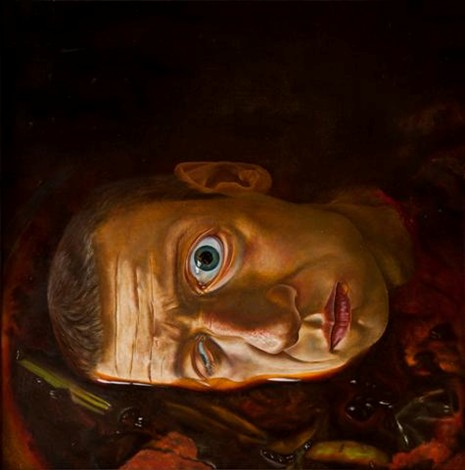
I’m thinking of begging for money, opening up a Go Fund Me page or something to be able to make it to Vilnius before March 6th when the following exhibit will end. Here are a few of the milder images:
I first encountered the paintings and visual art of Šarūnas Sauka while wandering the streets of Vilnius in 2006. I walked past a small gallery with a modest glass door and was struck by a portrait of a woman that seemed to recall the work of Ivan Albright, another of my favorites. When I went inside, I was completely transfixed. The gallery contained only a few paintings by Sauka, but each one slaughtered me. It was the kind of painting I had waited my whole life to discover.
If you’ve never seen his art before, be warned: he’s not Monet. I feel his work is more intense than Egon Schiele’s or even Joel Peter Witkin’s. This video presentation of the exhibit will give you more than a solid introduction. That it’s set to the music of Massive Attack only confirms all the feelings of synchronicity I sense whenever I engage the art of Sauka.
If anyone would like to donate a few dollars to send me out to Vilnius before March so that I might write a long essay about why his work should be required in all the world’s high schools, please PayPal me.
The reason I’m asking this question is because The Next Best Book Blog has run an interview of me today (click here) . It’s a series called Would You Rather, and the header asks a rhetorical question: Bored with the same old-fashioned author interviews you see all around the blogosphere? I had a load of fun answering those questions and I hope you’ll check it out.
I got to thinking during the interview. I’m not like those authors who want to cut themselves when they hear “Where do your ideas come from?” or “What are your greatest influences?” As I blogged yesterday, I often forget my influences, but I also feel a bit ashamed about them; so many are the usual books writers are “supposed to know”. Still, if I had to pick from among cliches and sentiments, I’d rather answer questions like, “Does an artist have a responsibility to society?” or “Is there any way to bring back the noble hero?”
Asking a writer where ideas come from is obviously loaded, and to certain parties can be a put down. What do you mean where do my ideas come from? They come from me. I know a lot of people assume they “lack ideas” (they don’t, and more about that in a moment), and ideas must “exist somewhere”. But how would we feel if we asked a writer, “Hey, where do you get your ideas?” and s/he answered, “A vending machine outside Hammond, Indiana.” Would we seek out that machine? Would the art be interesting, then, if you could buy it for a quarter?
Any time I hear a piece of beautiful music or read an amazing book, I’m stunned by the artist’s creation. It’s shocking to think there existed nothing, but then an artist came around and released a symphony or an epic poem or a monumental sculpture straight out of empty space. It must have a source! Where? Tell us where!
That hope for a source is worth investigating.
I had a neighbor once tell me—most writers hear something like this—that, despite never having written a thing, she should write a book about her life. I asked why. Oh, she said, my ex-husband cheated on me, and I had a tough childhood, and my eldest daughter is in therapy over my ex-husband’s affairs, and I used to work in hospitality but I quit because I thought I’d raise a family.
She felt the weight of all this experience, all the sadness. I could sense it. But was it all that different from what anyone else has ever felt? Who knows. The book she imagined doesn’t exist. She never found (or carved out) time to sit and write.
Curious things happen when you force people to sit and write. I see it among my community college students. Most of them—perhaps 90% of them—believe they lack ideas. They’ll prove it to you: ask them to write a regular old college essay and it will drip with “say no to drugs” and “it’s unfair to be judged” cliches high schools dump into young brains. But when you make them freewrite—just keep pen to paper for ten minutes without pause and allow whatever comes to come—all kinds of intimate surprises appear.
If you want to know where writers’ ideas come from, try freewriting. When you see what’s there, what came from you, ask yourself which of those bits you’d be willing to develop and share with strangers. That’s what a writer is. We share the bits most people pack away while wondering where the good ideas are.
This is a blog version of the story I told on December 14th at Is It a Thing, a monthly spoken-word series here in Chicago. I’m dedicating it to my good friend Kerri Smith Majors, who asked me to write it. Note: the post contains excerpts from The Fugue.
Here’s the question posed in this entry: What did editing a manuscript I had not looked at for more than a half-decade reveal about my PTSD?
I’ve already blogged about the 15 year path that led to the publication of The Fugue. The first words came in 2000. Once finished, I failed to sell the manuscript and put it away in 2006, later beginning work on a new project, what eventually became Finding the Moon in Sugar. I considered The Fugue a failure and stopped trying to get anyone interested.
A short time after I self-published Finding the Moon in Sugar (2009), I ended up diagnosed with PTSD. Its onset came after* I got caught in a convenience store robbery, which I blogged about in this entry titled Gunpoint. To summarize: I was certain the robbers were going to kill me that night, and I accepted my death while watching the robbery unfold, reflected in store windows.
I obviously survived, but not unscathed. Within a few days, I started having PTSD symptoms. My PTSD was (and sometimes still is) like a bad and incessant acid trip, complete with phantom sensations, memories of voices, unusual sounds, smells, flavors and inexplicable visions. The visions can be hallucinogenic and dreamlike or frighteningly realistic. I’ll write about them some day.
Doing something as simple as brushing my teeth or making a cup of coffee often brought on confusing sensory overload. My body experienced “phantom pains”, especially in my face and ribs, and my throat would constrict. I’d want to run and hide but could only sit somewhere and trip balls. I’d get lost in neighborhoods I’d known all my life, the street signs resembling electronic tickers, letters of all languages flying in them at unreadable speeds.
In order to heal, I had to make dramatic changes to my lifestyle. With guidance, therapy, a commitment to health, mindfulness and Zen practice, and the help of many loved ones, I eventually learned to manage my symptoms, even to neutralize or eliminate some altogether. Writing helped. So did telling my story in public.
***
In 2014, I was reading from Finding the Moon in Sugar in a bar. During that reading, I met Jason Pettus, the owner of The Chicago Center for Literature and Photography. He asked if I could send him some material to review, and soon enough he offered to publish The Fugue.
I had last looked at the manuscript sometime around 2008. When Jason and I started editing, I was shocked by some of the things I found. The main character, Yuri Dilienko, grows up in a dysfunctional, abusive family, its members traumatized by war and other events. He also ends up in prison for over a decade, found guilty of arson and parricide.
Early in the narrative, a character suggests Yuri might have PTSD. Of course, I had completely forgotten this. Then my descriptions of PTSD “in the moment” left me thunderstruck.
In this excerpt, Yuri’s just been released from prison, has moved back to his hometown and is thinking of getting a job in a bar. The reason he hesitates showing his hands is because they’re dotted with scars suffered in childhood:
—
He noticed a “Help Wanted” sign hanging behind the bar, so low that only people at the bar could read it. Maybe this was some kind of subtle joke, because people who sat at bars usually needed help. Yuri imagined working there. Most of the men were only drinking beer, and if they ever wanted something different, scotch and soda, Yuri was sure he could mix it.
“I’m sorry.” Yuri spoke to a bearded man. “Excuse me. I’m sorry.”
The man perked up. “What for?” He lit a cigarette.
“That sign there. Below. The Help Wanted.”
“The sign? Oh, for the job?” He rattled and stuttered: “Yeah, that’s…that’s for the job.” The man coughed into a loose fist. “Hey, Sonia!” She stepped over from the bar’s other end. “If you want the job,” he told Yuri, “Sonia’s gotta read your palms.”
All the other men now seemed interested.
“You wanna job?” asked Sonia. “Is por bartender. We have the day position.”
Yuri shrugged. “Daytime? You mean what? Noon?”
Sonia smiled at him. “I see your hands. Both hands.”
Yuri hesitated. The whole bar was watching him, some of the men grinning. He wanted to take his cane and tell the people he was very sorry, it was a big misunderstanding, because he had to go. While looking at their intense faces, pockmarked skin, lopsided mustaches, Yuri felt surrounded by the most violent men—grotesque and incapable of compassion, their eyes the color of mortar. His mind began racing, as it did often when he found himself confused or surprised. Strong, hard hands grabbed at him from all around and a shiver buzzed over his entire body, electric over his chest. He was powerless and could only give in, curl up, let the blows come, let them pass, then bury rage and fear deep in his center, deep into his pelvic bones and base of his spine.
—
In this next scene (slightly edited), Yuri is working in a butcher’s shop. It’s only days before the house fire that will take his parents’ lives:
—
A powerful force in his center, like a glass sphere packed with the molten heat of a red sun, wanted to charge up his throat.
At the end of the workday, Reikel smiled to Yuri as he left, said, “See ya Monday.” On the way to the bus stop, Yuri threw up his lunch…popcorn, salami and apple juice. This was the third time he had thrown up, the onset of nausea unexpected, gone as soon as he had vomited, since he had shown Reikel his hands. Nobody ever saw Yuri vomit.
Cicero had become a ghost town surrounding him. Hundreds of sparrows were chattering in a small yellowing elm. Their bickering and chirping grew so loud and overwhelming that Yuri stood entranced until a woman exited a nearby car.
On 12th Street, he saw his bus lumber away without him, so he went to a diner to rinse his mouth in the bathroom and wipe his face and chin to be sure he was clean.
Once home, he couldn’t sculpt. Every idea and sketch seemed pointless and stupid. He was always hungry, although nothing tasted good and no drink quenched his thirst or whet his constantly dry mouth. The hardest place to be in all of Cicero was home. While he sat in his kitchen, it felt as though parts of him were gradually disappearing. Yuri felt extreme nervousness, a shifting fuzziness in his periphery, and that powerful glass sphere inside him.
Everything required hands. At Reikel’s, his hands seemed to do what he asked them, but at home they refused to obey. Everything required hands. Warming up a plate of leftover macaroni and cheese. Washing himself, his entire body…before he could wash his body he’d have to wash his hands. Flipping through the sketches on the table seemed such a chore. When Lars used his hands, music came so easily, like air through a wide open door. Yuri could tell that Lars never thought about borrowing hands or finding new ones, and he didn’t have nightmares that his hands were left wrapped up in aluminum foil at the bottom of a paper bag…
…Whenever he awoke, he had trouble knowing what day it was. He found busses running on the Saturday schedule. Weekends were the worst because he had so much time to sculpt but found plenty of excuses, shopping for things he didn’t need—paper clips and deodorant—always walking to the largest stores on 22nd with the biggest crowds. Among these people, nobody knew. Sometimes Yuri walked out on the yellow lines in the middle of 12th Street’s busiest traffic and felt completely invisible.
—
These are only two scenes among many more that describe what it is like to have PTSD. The sudden nausea, throwing up, the nightmares. The feeling of disappearing, of being invisible, even in traffic. The daydreams of beatings, and the simultaneity of rage and confusion, the constriction of the throat. How could I have known it to this vivid detail?
My wife thinks I have always* had PTSD, or an anxiety disorder of some kind, that the robbery just cranked up the volume. I might agree with this theory if, prior to writing the novel, I had known how it felt to “crank up the volume”.
Composing the book, I had very little information about PTSD, had read a few articles, knew some stories about veterans’ issues. I never intended this book to be a portrait of a sufferer and don’t remember thinking very much about it. Perhaps the way I imagined PTSD might be influenced what form my PTSD took. PTSD is, at least in part, a condition of the imagination, a disorienting fusion of memories and fantasies, delusions and recollections, their tone depending at once on the nature of one’s fears and experiences.
I can’t answer how this happened, except to say that I found it fucked up, a mystery of the creative mind. Obviously, plenty of characters in The Fugue experience things I never did—all novelists imagine experiences they’ve never had; we depend on observations or overheard stories to narrate them. But this brand of premonition, if that’s the word, left me fascinated. It’s a layer in the book I could never have anticipated but now can’t deny.
Longtime readers of Liquid Ink know how much I loved Suokalbis, the since defunct Vilnius dive, which in an essay that won’t go away, I called the greatest bar in the world.
Here’s an excerpt from Suokalbis, A Eulogy and Lament:
When an old man dressed in tan Soviet-era trousers gyrated in imitation of Freddie Mercury, and when his dance partner — a young woman who might have worked at the reception of an area hotel — swung her round hips to Fat Bottomed Girls, you knew what it was about. When you saw a scrawney trolley bus driver color his cheeks with lipstick borrowed from a tourist — one perfectly happy to hand her makeup over — and you watched the couple bounce around to Ra Ra Rasputin, Russia’s greatest love machine, you understood that Suokalbis had a purpose. The bar wasn’t merely a refuge for the city’s 86-list. It was a public space in Vilnius that experimented with the notion of absolute freedom.
I’m far from the bar’s only fan.
Filmmaker Arturas Jevdokimovas contacted me a few months ago about the essay, asking if he could use some of the text in his new film, Anthology of the Plot. Obviously, I agreed. The website promoting the film, which will make its way around the festival circuit, is now out, and I encourage readers to visit.
Among the challenges I faced trying to sell my novel, which took about a decade, was that my title, The Fugue, refers to something obscure. I actually fought with this title for a long time, and I came up with other ones, some of them embarrassingly bad. Obviously, no alternative title satisfied (for reasons I think most readers will—even without learning what those titles were—understand if they investigate the novel).
Still, I want to say some things about my title. Just the other day, at a library, a woman looked at a Fugue postcard I had given her and asked, “How do you pronounce that?”
One reason I found the title attractive was that the word has multiple meanings, and I explore all of them in the novel. I’ll guess most people will associate the word with music, primarily a polyphonic composition technique. Here’s how a character in the novel—she’s a teenage music student—understands a fugue:
Lita knew what a fugue was, a composition of usually two strands—voices—of music that borrowed short melodies and phrases from each other. It was like a game where melodies played side-by-side and pretended to be each other, or sometimes even became one another. They could weave together like braids or plaits, then split up and come back together again.
There’s also this educational You Tube video called What Is a Fugue? It really explains why these kinds of compositions are fascinating.
One of my favorite musical recordings is this one here, Ashkenazy playing Shostakovich’s Preludes and Fugues. While listening to that music with a friend in my Manhattan apartment back in 2000, I wondered out loud if it could be possible to write a work of literature on the principles of a musical fugue. Soon enough, I tried my hand. Whether or not I succeeded remains to be seen.
Of course, the word has other meanings. It’s a synonym of flight. That’s to say an attempt to escape, to flee a threat. One fate of those in flight is displacement. The Fugue deals with an entire community of displaced persons and their children.
The last meaning is difficult to discuss without a spoiler, so I’ll say little about it. When I was taking psychology classes in Urbana, Illinois, I learned about conditions known as “transient” or “dissociative” fugues, or “fugue states”. This National Geographic article tells of a contemporary case, and this book presents fascinating case studies. These days people think of the psychological states as forms of amnesia, but I’ve heard arguments that they are forms of schizophrenia or identity disorders. One thing seems common: in all cases, the person suffering from the condition has endured a horrifying trauma.
The book launches next week. I hope you check it out.
I’m happy to announce that the pre-launch for my upcoming novel, The Fugue, is underway. You can find pre-order information here at the CCLaP website. I also encourage people to check out what kind words Jason Pettus, CCLaP’s owner, left on the novel’s Goodreads page. “This is the literary novel for those who love literary novels…”
The Fugue started out back in 2000 when I was a student in New York. One night I wrote a vignette titled “Juri’s Window”. Juri was a painter and sculptor living in Amsterdam, perhaps in the mid 90’s, where he collected unemployment benefits and sculpted from trash. The vignette was simple: a description of a window Juri put together out of glass bottles and the remains of a discarded fence. I looked at it as a writing exercise.
But this character pestered me, kept appearing in my work. Soon the name had changed to Yuri, and he had a family, a girlfriend. Later, I moved him from Amsterdam to my hometown of Cicero, and his family gained a complex history of flight and displacement. Eventually he’d been accused of arson and murder. I realized I had a novel.
I messed around with various drafts for years. But in the summer of 2006, at that time working in Bloomington, Indiana, I felt the book, clocking in at about 135,000 words, was finished, and I started trying to sell it, going about it in the traditional way, sending cold queries to strangers.
Mind you, obsessed with The Fugue, I had not published a single piece of short fiction at that point. I don’t know how many rejection letters I collected—for a while I had been assembling them in a scrapbook, but in time I had no place to put them, and far from motivating me, they were just trash mail, most of them the usual form rejections. What kept me writing queries were the nibbles. This Midtown agent asked for the first 50 pages; that Chelsea editor asked for the manuscript. Now another agent wanted the whole thing. After reading, she told me her colleague might be a better fit and forwarded the text along.
The people who read it in whole or part all said about the same thing: “You don’t have a platform, and this book’s too difficult to market.” I took to heart that they didn’t say, “Your writing is shit.” It left me enough to maintain the feeling that I could be a writer. But I hung up The Fugue as a failure and set it under the bed, so to speak.
In the summer of 2007, I started writing Finding the Moon in Sugar, a project that occupied the years leading up to my first child’s birth in 2009. And then I took on smaller writing assignments, including a stint with The Good Men Project.
Part of the reason I self-published Finding the Moon in Sugar was to get my name out there. I wanted to have something gripping but fun to read from during events, and I thought the best way to learn how to market a book—a work of literary fiction, to the point—was to get out there and try to do it.
Last autumn, 2014, I was reading from Finding the Moon at RUI, a reading series here in Chicago. I hoped, at best, to sell a couple of copies, maybe learn about some new writers. At the bar, Sheffield’s, I ended up sitting next to a man, Jason, who had a lot to say about selling books. Turned out he had a publishing house. After my reading—I read the scene when Andy hears opera music for the first time—Jason asked me if I had any short stories. Sure, I said. I have plenty. But when I checked out his website, I figured, what the hell. Maybe I’ll tell him about The Fugue.
This holiday season, the book that started out as a vignette will hit the shelves and e-readers. In anticipation, have a look at the cover. It’s gorgeous:
WARNING! This link will take you to a video of an actual vasectomy. While I highly encourage people to watch it—all surgery is fascinating, and this is the kind of “no scalpel” procedure I had done—I should state that it presents a tug of war between stainless steel instruments and very thin and sensitive body parts.
I was never this nervous going into a medical procedure. I’ve had four wisdom teeth beaten out of my skull. I’ve had my wrist screwed together. I had to get plantars warts burned off of my sole with a laser. Nothing quite compares to lying on your back mostly naked with your shaved scrotum (I did it myself) the focal point of the afternoon.
Weeks before the surgery, my doctor had explained the procedure in pretty vivid detail. Of course, my writer’s imagination had gone wild, and it did not help to see, so soon as I had entered the room, a stainless steel tray holding almost a dozen surgical instruments, and also gauze smeared with iodine, the color of brown scabs. I knew it was iodine. But iodine recalls the color of coagulated blood.
There I lay, nards under a tissue-thin square of sky blue paper, and the doctor came in with a host of people: four (at least) medical students, all of them preparing for lucrative careers of nard hacking. In the small room, I soon developed a sense of claustrophobia, this while my testicles swelled to the size of peaches. Supine, I stiffened to a board, sweat beating my brow, the room a trash compactor, my nards now ripened Michigan fruits, their skin red and downy. And I had a multicultural audience wearing scrubs.
I was wearing my dashiki. The doctor said, “Hey, this shirt looks Caribbean. Let’s put on some Caribbean music.” Songs by Mark Anthony and the loathsome Ricky Martin streamed from a corner. The procedure had begun before Ricky could sing Go go go! Ole ole ole!
“You’re just going to feel a pinch.”
Indeed, a pinch, if that’s what you want to call a needle stabbing your sack. I tried to be mindful, as my Roshi had trained me, but my mind went rather haywire, and I started hearing all sorts of idiotic associations, including the jingle, “You save big money when you shop Menards.” It did not go well with Ricky Martin, not when Raymond Jack Szmanda (the Menards guy) danced before me, his nuts bleeding.
The doctor was training his students, explaining all sorts of things about skin and vessels and placement and tools, and using words like cauterize, and a nurse kept handing him some branding rod attached to five million watts of electric death. I could smell my testes burning.
It hurt to be yanked around. Not the way it hurts when you stab yourself with a screwdriver. But the vas is short and rather thick, thicker than you imagine; the sound and vibration of cutting it was similar to what I felt when I cut my kids’ umbilical cords. There’s also very little room to maneuver, and with so much attention on me, I felt I was in a toaster.
I was pouring sweat. The doctor opened the door to let in air. This made a nurse feel she could now come in to ask random questions. “Just one quick question, doctor.” Are those Michigan peaches? Could someone cauterize Raymond Jack before he bleeds all over the floor?
The stitching required more yanking, more explanations, “These are going to dissolve.” Dissolve? How? Where? Into what? “We won’t need to remove any sutures.” You’re damn right about that. “Oh, good. Rihanna is on.”
Now that I was all stitched up, nauseated, a dripping human sponge of sweat, the doctor asked me, his hand on my shoulder, “What kind of music do you like?”
“Me?” I gasped. I found the breath to say, “Tom Waits.”
The doctor and the audience exchanged clueless glances.
“Should we know him?” he asked.
I nodded. “If you die today, what deity you believe in will meet you at the gates of paradise. And you’ll be asked, ‘Do you like Tom Waits?’ Answer ‘No’ and you’ll go to hell where five strangers will cut your genitals.”
They all guffawed. “We’ll look him up. We’ll look him up.” The doctor patted my shoulder. “You did great. You’re all done.”
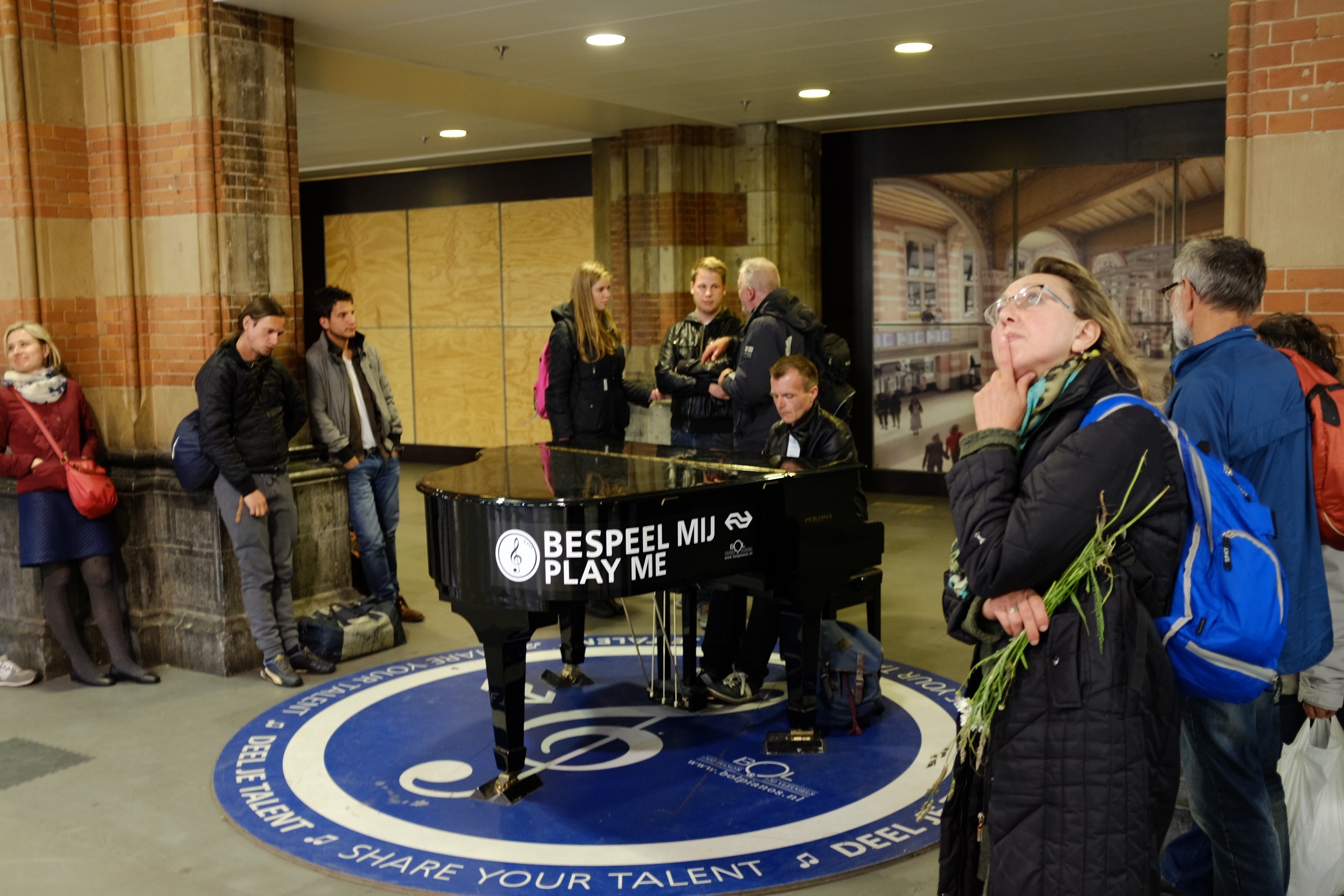
Here is a video of a homeless man playing a public piano in Sarasota, Florida, as part of the Sarasota Keys Piano Project. It requires no introduction or commentary.
My first experience with a public piano was this past spring in Amsterdam where I took this photo:
That moment was about as great an experience as I have ever had with public art. I stood by that piano for almost an hour, just waiting to see what kind of people would sit down to play; each time I returned to the train station, I walked by to see what was going on. People took turns politely, complimenting and thanking each other, and the pianists ranged from a few Asian tourists to very obvious commuters (as the man in the photo is most likely a Dutchman coming hom from work).
The piano music mellowed and calmed the experience of the busy train station. It also opened up the space and contributed to the rhythm. I was so moved by the music, the openness and trust experienced between the city, its residents and strangers, that I’m convinced every city should have multiple public pianos in places like train stations, post offices and outside the DMV.
Here’s the brilliant Dariya Marchenko making a humanitarian statement on the continued atrocities perpetrated by Vladimir Putin. This Reuters report should leave you provoked and moved. Daria assembles a portrait of Putin from bullet cartridges collected from the front lines of the war in Ukraine, and the art is being presented in conjunction with a novel (which I’d very much like to read).
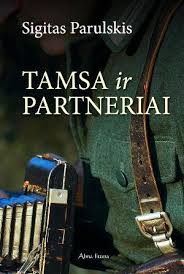
I took the liberty of translating this from the jacket of a book I’m really excited to start reading. There’s no English translation, sorry, but there really should be one.
The perpetrator and the victim learn the real truth, but the witness, the observer gains only an impression. The quality of that impression—is it stronger or weaker—to tell the truth, there’s no difference. One way or another, the impression will die out, become a distant, faint memory, but the victim and the perpetrator will never forget the truth. –Sigitas Parulskis, Tamsa ir Partneriai (Darkness and Partners)




 Liquid Ink
You must be logged in to post a comment.