Liquid Ink

The official website of Gint Aras, Finalist 2016 CWA Book Award


The writer who doesn’t read books

I was at a book sale and signing event recently, sharing a table with another writer. The bookstore, located in a place with virtually no foot traffic, was near-empty, and the only people who came to our tables were interested in getting our signatures so that they could use them to enter a raffle the store had organized. My table partner and I spent the time talking about the usual things: book marketing strategies, the publishing industry and our current projects.

Eventually, I asked the guy, “What are you reading?”

He shrugged and said, in a tone so casual to be almost dismissive. “Eh, I don’t really read books. I’m just not really into them right now.”

I had no way of preparing myself for this. The guy was young, in his mid-20’s, right at the age when I had discovered writers who would remain favorites for the duration of my life, whose influence on my writing will never evaporate. He was at the age when I—no children or frightening responsibilities in my life—read between two and three hours each day, towers of books on my nightstand, desk and toilet tank. To this day, I don’t ever leave the house without a book in my bag, so I simply couldn’t hide my shock. “You don’t read?”

“I mean, I do research for projects. I like to study, mostly, so I get stuff from the internet. But I just don’t read books right now.”

I started stuttering. Perhaps I appeared offended. The experience was painful, stinging, unfathomable, inexplicable…I felt strain in my stomach and was overwhelmed by an urge to clench my teeth. “So, how do you work on craft without looking at stuff written by people who are better than you?”

“Eh, I get feedback. I’m in a writer’s group.”

“And…these writers. Do they also reject books? Do they ever tell you things like, ‘Your writing reminds me of such and such?’”

“Maybe they like books, but we don’t talk about it. The group is all about writing, so we focus on that.”

I sat with his answer for many minutes, feeling the silence stretching between us like a bungee cord about to kick back with the force of a falling elephant. I imagined the guitarist who did not listen to guitar, the painter who did not look at paintings, the doctor who rejected convalescence, the teacher who had nothing to learn. On any level, in any environment, the sculptor who had no use for sculpture would be considered a buffoon. If a singer came to a singing coach to reveal she had no interest in listening to song, the coach should send her packing. Yet this young man sat cocksure and certain of his intrinsic talent. Reading would be an admission of either weakness or incapacity.

I finally asked him, “How do you rationalize selling books to people when you don’t want to buy or consume books yourself?”

“Yeah, I get that point. I mean, it’s true, I guess, kinda. But I just got so many things on my plate. I don’t need to read someone else’s stuff to sell my own.”

I realized I was the only person to have ever asked this man that question. His education and culture must have reinforced his position as reasonable and rational. Still, I’d have a much easier time with the pharmacist who knows her wares are poisons just as I could get my head around the grocer who sold high fructose corn syrup without ever eating it himself. But…dude…these are books.

Books.

In America, in the 21st century, it’s not just the president and his followers who don’t read. Some writers have also joined their ranks.

The_House_of_Leaves_-_Burning_4

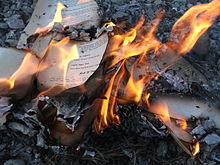
Photo of a contemporary book burning from Wikipedia.


Your right to hate speech

This should only be said once.

Dear Nazis, no one is taking away your right to spew your hatred. You’ve been doing it all along: on the Internet, at dinner parties, on bar stools, during Thanksgiving dinner, and now in Portland, where you were met with opposition.

The reason you believe you’re being oppressed or denied rights is because you conflate your right to spew blather, ignorance and mental sewage with the listeners’ need to believe you or agree with you. This is how freedom of speech works. You stand up and spew your hatred, express your ignorance, make public fools of yourselves, and your peers duly note it. When you stage your protest, the counter-group stages theirs. That’s not a denial of your rights. On the contrary: it’s you expressing your right to stand up in public and say “I’m an imbecile!”

We know, and we’ve known all along.

There’s a reason most people don’t believe you. You’re blatantly and idiotically wrong, and your world view is psychological and sociological pollution. Your loathing is based on a false perception, on constructs you’ve never taken the time to investigate or think over. Your ideas would bore most of us if they didn’t lead to violence and the destruction of lives.

It bothers you to witness those you loathe supported politically or enjoying economic success, larger acceptance into mainstream society, or just greater confidence to walk hum-drum down city streets as everyday people and not “others” or “freaks”.  You believe that the success of those you loathe disenfranchises you. That’s to say your power or station in society is not actually the result of anything you yourselves can do or manage. In order for you to feel secure, you need someone else to be struggling or denied their humanity. “How come I’m not wealthier than these people I hate?” Good question. Don’t most of you believe that you get what you deserve, that individuals determine their own fates all on their own?

Your mistake is to think that power and acceptance are ladled out like soup. More soup for “them” means less soup for “you” until the whole pot has been distributed. Forget about the idea for a moment that the difference between “them” and “you” is constructed in your mind. If you woke up to see that your neighbor’s success actually makes your life easier, you’d have no need to raise your right hand in defiance of your society’s democratic values.

But you won’t ever see that. It’s obvious. Every time you speak freely, raise your hands into the air, you make that perfectly clear. It’s clearest when you stand up and wonder why you don’t have the right to speak freely, as if you’re unaware that you’re speaking. That has always been to most baffling part to me. It’s always the loudest and most hateful drunk in the bar screaming “Why isn’t anyone listening to me?”

Soap Box


Leave a comment

Flooding damage

I had a clogged sewage pipe. The basement flooded, about five inches of water. All sorts of stuff needs to be discarded: rugs, mattresses, clothes. But there are two things that just ripped my heart to shreds.

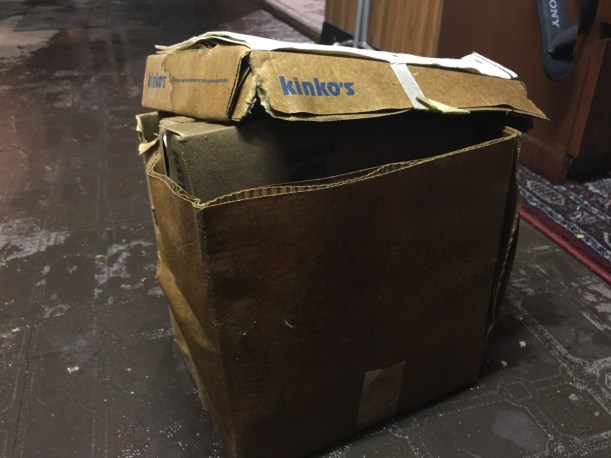
This is a photo of the box that contains the only hard copy of the novel I wrote while living in Europe between 1996-1999. About a Lithuanian orphan who ends up influencing the life of an historian from Santa Barbara, it was never published. Yes…like The Fugue, this one was just sitting on the floor somewhere.

My wife fell in love with me while reading this book. I developed friendships while writing it, and I became myself as a writer, found my voice somewhere in the middle of it. It contains some of the worst sentences I’ve ever written, so pathetically, honestly unfortunate that they represent an organic beauty I’ll never know again.

IMG_4049

The text is ruined. Also in the box were critiques of my writing I had collected from classmates at Columbia, some of whom have gone on to become quite accomplished and acclaimed writers.

The other damage is a box of letters. Those letters date back to the late 80’s; many of them are in old air mail envelopes. The box contained post cards from ex-girlfriends, letters from men who had witnessed the Soviet crackdown in Lithuania; it’s just a box of treasures, memories, mementos, documents to make sense of my identity and past. Many of them will be saved, but some of them are just trashed.

My computer and cameras survived. So did my tax papers and all sorts of stuff money can replace.

Move your treasures to higher ground.


Leave a comment

My reading at Waterline (video)

Here’s a video of me reading from The Fugue, as recorded by the good folks at Waterline Writers Reading Series in Batavia, Illinois.

If you’re interested in the writing workshop I’m leading, click here.

Gint Aras at Waterline Writers: March 2017 from Waterline Writers on Vimeo.


Leave a comment

How to deal with a narcissist

I’ve been reading accounts from the American press written by journalists stunned to find Trump is worse beyond their expectations. I obviously don’t share their sentiments. I’m an abuse survivor, grew up with a (much less wealthy) Donald Trump in the house, and have the misfortune of currently working with a Donald Trump heading my place of employment. Over the years, I’ve seen what sort of madhouse network dances about men like our president.

Get used to it, America. We are now an abusive family.

Abusive families have three primary players: the abusers, the enablers and the victims. If it isn’t clear, the abuser (Trump) dishes it out while the enablers (the establishment) make excuses for it, attempt to rationalize it, sometimes to benefit from it, thereby supporting it, while the victims (citizens) take insults and deal with disorienting confusion, even chaos.

It’s more complicated and shaded-gray in reality. All sorts of professional people have broken these roles down further. Obviously, there’s overlap between them.

Most abusers were once victims, and still perceive themselves, like Trump does, as mistreated or unfairly targeted. Some enablers also abuse, but all enablers are victims of the abuse, at least to some degree, if even by virtue of needing to depend on it to play a role, complete some task or access a resource. From my point of view, victims are enablers until they remove themselves from the system, decompress, gather their bearings and accept, with as much clarity as possible, what the abuse was truly like. This requires admitting it. They have to make a conscious decision that the abuse stops with them or it simply won’t.

Most of us are nowhere close to that point yet. This is new and bizarre; we’ve been dropped into the madhouse and can’t tell where to focus our attention. It explains why so many of our journalists and other professionals are staring ahead wide-eyed, mouths agape, making delusional claims like “this might lead to totalitarianism” when a totalitarian is already in control, when reporters are being arrested for doing their jobs and protests outlawed in the wake of idiotic, distracting tweets and abject falsifications of reality.

It’s important for everyone in a position of influence, from every level of our government to the whole of our press, our institutions of education, social services, our courts and our legal professionals to understand something unequivocally. Our president is an abusive madman, a narcissist with no capacity to change, no ounce of empathy, no motivation beyond his own aggrandizement.

Showing him photographs to contradict his delusional claims is pointless. Narcissists cannot be “managed” or “influenced.” In my experience, there are only a few ways to deal with a narcissist, none easy or comfortable.

The first is a war of attrition, the arsenal merciless, consistent insult. The insults do not have to be exotic, vulgar or vindictive; speaking about reality, consistently and in a sustained effort, is enough. You’re not very well liked. Most people abhor you. They disagree with your values. They think you’re uncivilized, deranged, mentally ill and unable to grasp reality. Repeat. Repeat. Repeat. Do it in shifts, like an oiled hockey team crashing the net. He makes a false statement, so you dismiss it, call it a lie and immediately set about ridiculing it in every possible channel, making certain he sees it.

A narcissist will try to exhaust you until you give in, until putting up with whatever the narcissist is doing becomes easier than listening to his assault on reality, or hearing the insults. It’s exhausting, obviously, to tell the narcissist, “No. The tablecloth is white, not yellow,” every time you deal with him. But that is what we must expect. When the president speaks, he is fabricating a delusion in an effort to exhaust our imaginations and mental capacities. He wants to shell-shock us into submission.

Trump will not stop lying. In fact, he’s going to need to lie more as his administration unravels, as people begin abandoning him. He will not respond to reason or rational conversation, and he will continue sending his representatives to meet the press and lie that they intend to tell the truth, one second after they lie.

This seems counterproductive, even masochistic. A narcissist does not lie merely because he can or because it provides him attention (narcissistic supply). A narcissist’s lie gives him power over others’ imagination and feelings. The lies become the parameters of the discussion—we argue over the delusion instead of weighing the reality—and anything the narcissist doesn’t like he’ll claim has been invented by his victims. The technique renders reason useless and obliterates the basic agreements among the educated; you cannot argue with someone who makes up numbers, contradicts himself constantly or tells you your information is fake, what you’ve witnessed is false.

This latter point is most important. An abuser will beat you up or molest you but then accuse you of imagining it. He’ll accuse you of being unfair, of trying to make him look bad when you show everyone your bloody nose. What’s true is what he says; he is the center, the ultimate reference point. Everything, including reality, is subject to his power.

Attacks on a narcissist, in the short term, only increase his bluster. Eventually, however, the embarrassment of enabling him becomes a liability. At that point, exile becomes an option, but it requires a critical mass of enablers to stand up and say they’ve had enough.

The press cannot in good faith come to press conferences and ask Trump’s secretary, “What lies have you for us today? What bullshit of yours should we share?” However, our legislative branch can, and rather quickly, exile Trump to someplace outside the White House. Currently, Congress is Trump’s greatest enabler, far worse than the press, and getting worse as this horror show blusters on.

What will it finally take for our leaders to say they’ve had enough? Well…the usual thing. Massive opposition from an intrepid, inexhaustible, furious (but also clever) populace.

800px-narcissus-caravaggio_1594-96_edited


Leave a comment

Books: a threat to fascists

Two American classics, The Adventures of Huckleberry Finn and To Kill a Mockingbird, are again under assault. People have been calling for bans on these books since they were first printed.

Generally, two reasons explain why someone tries to ban a book. The first is the person’s ignorance of the book’s message. The second is that the person understands the message but fears it. In this case, both reasons might apply.

My purpose isn’t to advertise the name of the woman who called for the books’ ban or to draw attention to the school district temporarily and foolishly banning the books when they know exactly what they’re about. Interested readers can easily find this information. I’m here to counterpunch. An assault on any book, from the Bible to The Anarchist’s Cookbook, is an assault on all books. It contributes to America’s ever-growing anti-intellectualism and adulation of ignorance, which is often conflated as concern over someone’s emotions.

The worried mother claims the n-bombs in Twain and Lee disturb her biracial teenage son. Of course, instead of asking her son to be excused from reading, she wants the books removed completely. Her rationale: “I’m not disputing this is great literature. But there is so much (sic) racial slurs in there and offensive wording that you can’t get past that, and right now we are a nation divided as it is.”

Claiming offensive language interferes with whatever the books are saying is, in fact, a dispute of the books’ greatness. She either hasn’t read or misunderstands Lee and Twain. Her concern for a divided nation is transparent; because her boy finds the books offensive, she feels the rest of the school should as well.

Ironically, both these books provoke discussion about the nature of equality and unity. Curiously, the woman uses the same critique employed by people who fear what ideas these books might provoke.

These books should be difficult for any boy, biracial or otherwise. Great books slap us silly, shake us up and kick us. If the woman could “get past” the offensive word, one that should offend us in 2016, and battle through what violence children witness in the narratives (Huck’s dad is an abusive drunk, for example, and Scout haphazardly stops a lynch mob from murdering Tom Robinson), she could stumble into seeing that both Twain and Lee littered their books with n-bombs, in 1884 and 1960, respectively, while essentially arguing that black lives matter.

In short, these books agree that the biracial boy should be offended not only by words but by his society. Another lesson is that Twain and Lee are also provoking his Caucasian peers to see the consequences of racism.

That’s among the many reasons these books are part of our canon, and also why people have feared Twain and Lee’s critiques for as long as the books have existed.

*     *     *

Literature has always been a threat to those fascists who want to bait us into hating each other. They know it’s a remedy to growing inequality and division. I’ve met very few people who consumed it in large quantities but came away hateful, afraid of their fellow man.

Having consumed it in large quantities myself, I’ve learned it radical in 1884 to claim black people were human beings deserving of equal rights, just as it was radical to make the claim in 1960, and it obviously remains radical today. If not, it should offend no one to hear the phrase black lives matter. People should hear it and think, “Yeah, no shit.”

Despite my life in letters, I know far more Americans who see no use for literature. So many  believe individual words are more offensive than the act of banning them. These people are everywhere; I’ve found them in HR offices and among the administrators in schools. Our president-elect has no use for literature, just as most of his supporters seem to care little for it. Forget about great books—sketch comedy offends them.

People fear books because they want their flawed ideas and hatred either justified or hidden while they get to control the narrative. That has been the only reason books have ever been hated and burned, the only reason their makers are demonized as unpatriotic and brought out to face firing squads.

Of course, my critics will point out that this woman has the best intentions. She’s a leftist who wants a safe space for her kid, and she’s trying to protect him from racism. That misses the point. Her impulse might be to protect her boy, and she’s right to find the word offensive. But right beside this affront is an impulse to make everyone do as she likes.

It’s exactly the impulse of someone who has either read too few books or failed to gain their most important lessons.


the_house_of_leaves_-_burning_4

Photo, book burning, from Wikipedia.

“Remember it’s a sin to kill a mockingbird.” That was the only time I ever heard Atticus say it was a sin to do something, and I asked Miss Maudie about it. “Your father’s right,” she said. “Mockingbirds don’t do one thing but make music for us to enjoy . . . but sing their hearts out for us. –Harper Lee


Leave a comment

Readers ask: Should a writer travel?

Most questions about writing are loaded, and they require reading between very many lines. They usually are versions of these two questions:

1.) Will such and such make me a better writer?

2.) Will such and such help me get published?

We should note that those questions are not about the same thing. If getting published required someone to improve their writing, a lot of currently published bestsellers would have never made it past the acquisition editor’s desk.

The only thing a writer should do is read and write. You really can’t do one without the other, not if you want to compose engaging texts. That’s the short answer.

The long answer is more interesting. Will travel make someone a better writer? Travel, when done outside all-inclusive resorts, builds empathy. It offers alternative points of view. Travel enough and you’ll learn that everybody considers themselves the center point. I’ve heard people from at least six other countries tell me they come from the greatest country in the world. (Russia, Canada, Australia, Germany, The UK, New Zealand)

Travel also disarms the traveler. It can, when done with the right purpose, displace mythologies. Travel raises questions that have no answers. It also displaces common explanations. Why was Rome built where it stands? Well…there’s the Tiber. Yes, but Rome stands elsewhere, not just on the banks of the Tiber. Fifth grade geography class has its limitations.

All of those things make someone a better thinker and citizen but not necessarily a better writer. We can work on our observations skills in our bedrooms. Their application on trips really does reveal things that are otherwise invisible.

Of course, some of the best writers never really went anywhere. One thing they all did, however, was read, and they read whatever they could get their hands on. Travel is fun and engaging, a much more rewarding way to pass the time than, say, watching NFL games. It’s not as expensive as people think, certainly not when compared to its benefits. One thing I always have in my bag when I’m traveling is a book. It’s usually written by someone very different from me.

220px-douglas_dc-8-32_n804pa_paa_ams_12-03-67_edited-2

Photo from Wikipedia